
St. Petersburg · Pinellas County
Water Heater Repair and Replacement in St. Petersburg, FL
If your St. Petersburg heater lives in a garage and is nearing the end, a heat pump replacement could cut what it costs to run. What the job costs up front depends on the house, and St. Pete's houses vary more than most. Whether the heater needs repair or replacement, we connect you with a local pro in St. Petersburg.
Old Northeast to Tierra Verde and the beaches, around the clock.
Water heater repair and replacement in St. Petersburg
St. Petersburg was incorporated as a town in 1892 and as a city in 1903. Its seventeen mailing ZIP codes, home to about 341,000 people, take in the city itself and a string of neighbors that share its postal name: Gulfport, South Pasadena, Kenneth City, Lealman, Tierra Verde, St. Pete Beach and Pass-a-Grille, Madeira Beach and the Redington beaches.
The housing is old by Florida standards. By Census count, about 12% of homes before 1950, 21% in the 1950s and 21% in the 1960s, so more than half predate 1970, with another quarter from the 1970s. Old Northeast, one of the city's earliest planned neighborhoods, was built mainly in the 1920s and 1930s, with brick streets, Craftsman bungalows and Mediterranean Revival houses. Across much of the rest of the city, block homes from the 1950s and 1960s dominate, many built as the city spread north and west after the war.
That means heaters in a remarkable range of places. In bungalows, they sit in utility rooms, closets and enclosed porches added long after the houses were built, sometimes over wood floors. In mid-century block homes, they are usually in a carport closet, a laundry room or a garage. Downtown towers and beach condominiums keep them in interior closets, and newer homes in garages. Most houses are on their fourth, fifth or sixth heater, often connected with valves and fittings that are older than the tank.
About 8% of homes are held for seasonal or occasional use, according to Census data. Nearly all heaters are electric. The city buys its water from Tampa Bay Water, the regional wholesaler, and it is treated at the Cosme plant in Odessa, which has operated since 1930, before traveling about 26 miles to St. Petersburg. The regional supply blends river water, desalinated seawater, reservoir water and groundwater.
Our St. Petersburg coverage runs through ZIP codes 33701, 33702, 33703, 33704, 33705, 33706, 33707, 33708, 33709, 33710, 33711, 33712, 33713, 33714, 33715, 33716 and 33730.
What every job involves
Whatever the house, a replacement follows the same core steps. The technician isolates the heater from its power, closes the cold supply and relieves the pressure in the lines. The tank is drained, disconnected and carried out, usually to be taken away. The new heater is set level and connected, filled completely and purged of air before the power goes on, because an element switched on in an empty tank burns out almost at once. Then come the leak checks and the temperature setting. A straightforward swap is usually a single visit, with an hour or more afterwards for an electric tank to heat. Clearing a path to the heater before the technician arrives saves time, and in a condo, booking the elevator in advance does too. What changes the price is everything around that core, and the technician sets out the full figure after seeing the space and before starting. More on water heater replacement.
What moves the price in St. Pete
Where the heater is. An open garage is the quickest and simplest swap. A closet or porch in an Old Northeast bungalow means a tight doorway, floor protection and a longer carry. A condo tower downtown or on the beaches adds desk check-in, a booked service elevator and draining inside the unit.
What the old installation needs. In older houses, a replacement often reveals corroded connectors, a shutoff valve that won't close, a relief line ending in the wrong place or no drain pan over a wood floor. Each is a modest addition, cheaper now than on a separate visit, and in a bungalow on a raised floor the pan matters most of all.
A change of type. A heat pump unit suits a roomy garage but needs a condensate drain and extra height. Tankless saves space but needs a lot of electrical capacity, often more than an older house has. The installer prices either against a like-for-like swap.
Timing. A planned weekday replacement costs less than an emergency one at night or on a holiday, which is the main reason to act on warning signs such as rust at the base, rumbling or discolored hot water rather than wait for the tank to fail.
Disposal and parts. Removal of the old heater, new connectors, a drain pan or an expansion tank on a closed system should all appear in the price you're given, so there are no surprises when the work is done.
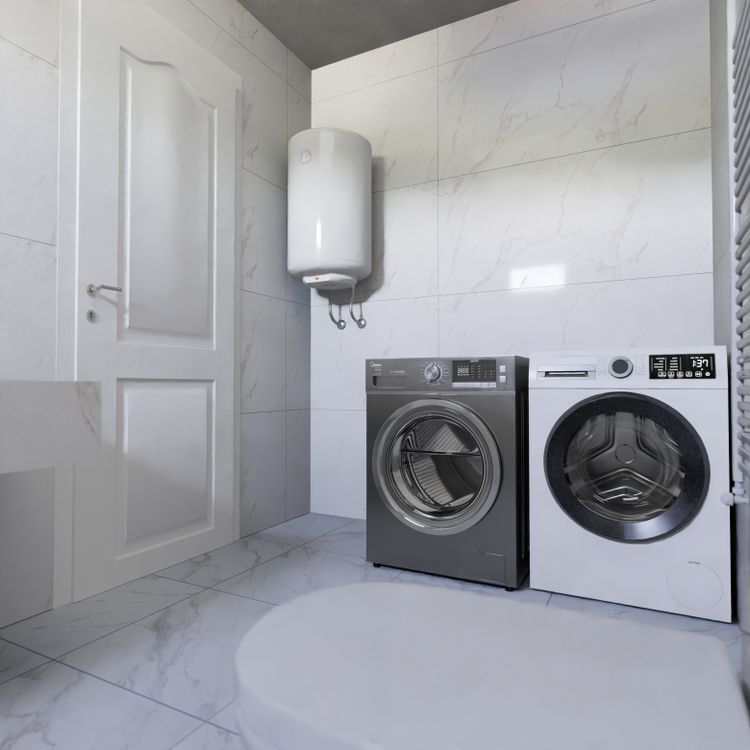
The installer checks whether your panel and space can support one.
Leak alerts for condos and closed-up homes
A heater leak in a bungalow closet or a condo unit can run unnoticed for days, particularly in homes left empty for the summer. Three layers shorten that. A drain pan with an outlet piped somewhere useful catches the first water. A leak detector on the floor sounds an alarm, and connected models alert your phone. An automatic shutoff valve closes the supply by itself when its sensor gets wet. In a condo above another unit, a detector protects your neighbor as much as you. Replacement is the easiest time to add all three. Before leaving for a long spell, shut off the water supply to the heater or the home, test the detector, and give a neighbor or the condo office a key and a number so an alert can be acted on the same day. See drain pan and overflow protection.
Back after the summer
Before the first shower, look around the heater and pan for moisture, rust or a mineral trail, and check the fittings on top for crust. Make sure the water supply is back on and the tank is full before the heater is powered. Run the hot taps for a while and listen as it warms up; new popping suggests sediment settled while it stood, and a heater that stays lukewarm may have lost an element nobody noticed while the home was empty.
If the hot water smells of rotten eggs while the cold is fine, the cause is commonly associated with a reaction in the still, warm tank involving the anode rod. It often clears with a few days of normal use. If it keeps returning, a technician confirms the cause and usually fits a less reactive anode, often alongside a flush. See flushing and maintenance.

Water heater services in St. Petersburg
- Heat Pump Water Heater Installation
- Tankless Water Heater Installation
- Flushing and Maintenance
- Condo Water Heater Replacement
- Drain Pan and Overflow Protection
Sediment out and the anode checked while the tank is partly drained.
St. Petersburg water heater questions
Are leak detectors worth it in a St. Pete bungalow or condo?
They're inexpensive and catch slow leaks early, which matters over wood floors and above other units. A basic detector sounds an alarm; connected models alert your phone when you're away. A technician can fit one in a short visit or during a replacement.
Could a heat pump water heater go in my condo closet?
Usually not in a small, enclosed closet, because heat pump units need a good volume of air and a drain for condensate. In a house with a roomy garage they're often a strong choice. The installer checks the space before recommending one.
For a St. Petersburg home, what does an automatic shutoff valve do?
A sensor on the floor by the heater triggers a motorized valve on the supply pipe. When the sensor gets wet, the valve closes on its own and the leak stops at its source, even with nobody home. It can protect just the heater or the whole home.
I rent in St. Pete and the hot water is out. Who do I call?
Contact whoever manages the property, the landlord or the management company, before anyone else; the lease normally sets out how repairs get arranged. If they would like you to ring us, or ring us themselves, a local pro will agree a time with you and settle the price with the person arranging the work.
How much noise does a heat pump heater make?
A steady hum from its fan and compressor while running, much like a small air conditioner. In a garage it's rarely noticed indoors. If the garage shares a wall with a bedroom, mention it so the installer can position the unit well.
Will a new heater fit in a closet shared with the air handler?
In most cases, yes. St. Pete condo closets are often snug, so the installer measures first and may choose a narrower or taller tank that leaves the air handler the room it needs for service and airflow. Tell us about the shared closet when you book so the right size arrives.
Why might replacing the heater in our Old Northeast bungalow cost more than in a newer house?
Mostly access and the state of the old installation. A heater in a closet or porch takes longer to drain, remove and replace than one in an open garage, and older houses often need new fittings, a working shutoff or a drain pan at the same time. The full price is set out before work starts.
Do you cover Gulfport, St. Pete Beach and the Redingtons?
Yes. We cover all seventeen St. Petersburg ZIP codes, including Gulfport, South Pasadena, Kenneth City, Tierra Verde, St. Pete Beach, Pass-a-Grille, Madeira Beach and the Redington beaches. Give us your ZIP code when you ring, and we'll put you through to a local pro who works there.
Nearby communities
We also cover Pinellas Park, Seminole and the rest of Tampa Bay.
St. Petersburg water heater repair?
Call any time for a local pro who works on St. Pete's bungalows, block homes and condos.
Every era of house, every kind of heater.