
Zephyrhills · Pasco County
Water Heater Repair and Replacement in Zephyrhills, FL
In Zephyrhills, the typical water heater is a compact electric tank in a manufactured home, tucked in a compartment or utility closet, often in a park whose residents come south for the winter. That shapes nearly every call we take here. Whether the heater needs repair or replacement, we connect you with a local pro in Zephyrhills.
Parks, subdivisions and country lots, answered day and night.
Water heater repair and replacement in Zephyrhills
The settlement began as Abbott in 1888. In 1909 Captain Howard B. Jeffries, a Union veteran, bought some 35,000 acres here to found a colony for fellow veterans of the Civil War, and on March 10, 1910, the town was renamed Zephyrhills. It was incorporated in 1914, and its downtown historic district was listed on the National Register of Historic Places in 2001. Three mailing ZIP codes, 33540, 33541 and 33542, now carry the Zephyrhills name, home to about 49,300 people across the city and the surrounding part of eastern Pasco County.
Census figures show steady growth rather than a single boom: about 19% of homes from the 1970s, 26% from the 1980s, 20% from the 1990s and 18% from the 2000s. A large share are manufactured homes, many in the area's numerous mobile home and RV parks, a good number of them 55-plus communities. There are also block homes near downtown and newer subdivisions with the heater in an attached garage. In a manufactured home, the heater usually sits in a small compartment reached from outside or in a utility closet off a bedroom, bathroom or laundry area, and it's typically a model built for that kind of home.
Zephyrhills is one of the most seasonal places in the Tampa Bay area. About 17% of homes are held for seasonal or occasional use, according to Census data, and many parks fill in the winter and empty out in the spring. That means a large number of heaters sit idle for half the year and then work hard for the other half.
Water divides the area too. The City of Zephyrhills supplies groundwater from its own wells, while many homes and properties outside the city rely on Pasco County's utility or on private wells. So two heaters a mile apart can age quite differently, and the technician will ask which supply you're on.
Calls from Zephyrhills are matched to installers covering 33540, 33541 and 33542.
Before heading north
A few minutes before departure saves a lot of trouble. Shut off the water supply to the heater or to the whole home, so a leak can't be fed while you're gone. If the heater has a vacation setting, use it; otherwise, ask a technician how best to leave it for your circumstances. Look over the heater and the floor of its compartment for damp, rust or a mineral trail, and deal with anything you find before you go rather than after six months. If the heater is well into its second decade, the weeks before you leave are also a sensible time to replace it, rather than leaving an ageing tank to stand unwatched through a hot summer.
Test the leak detector if you have one, and make sure its alerts reach you and whoever keeps an eye on the home, whether a neighbor, a relative or the park office. Leave them your number and show them where the shutoff is. Learn more about seasonal home water heater shutoff.
Through the summer
An empty home in a Zephyrhills summer is hot and humid, and a slow leak can run for weeks before anyone notices. In a manufactured home that matters more than elsewhere, because floors in many of them are built from materials that suffer quickly when wet, and a leak in a compartment is out of sight. A drain pan with an outlet piped somewhere that can take the water, and a connected leak detector that alerts a phone, are the two simplest protections. An automatic shutoff valve adds a third layer, closing the supply by itself when its sensor gets wet. Check the compartment's pan now and then too, since one whose outlet has clogged with leaves or debris gives no real protection. If someone looks in on the home, ask them to open the compartment or closet as well as walking through the rooms. See drain pan and overflow protection.
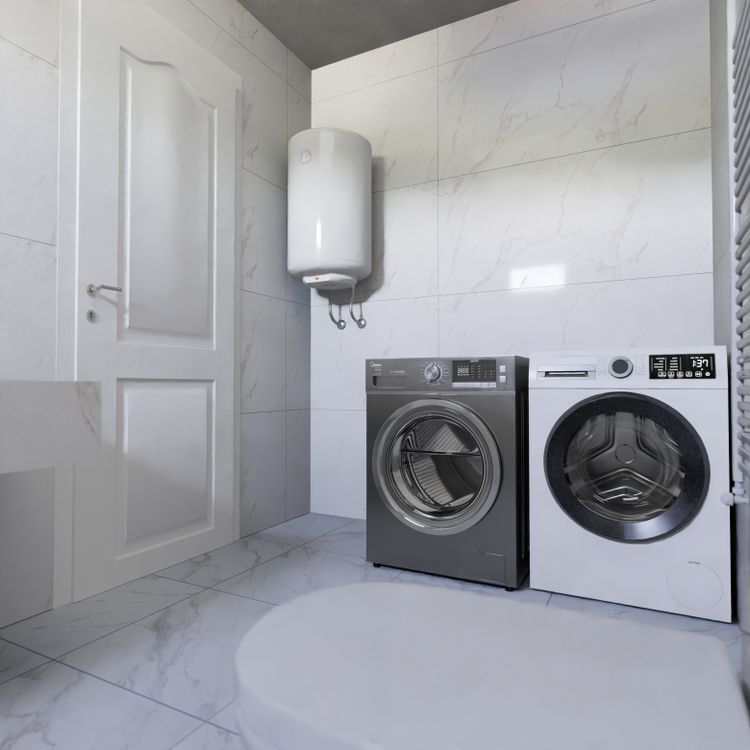
A look before you leave or when you're back, whichever suits your season.
Coming back in the autumn
Before the first shower, check around the heater and its pan for damp or rust. Make sure the water supply is back on and the tank is full before the heater is powered, because an element switched on in an empty tank burns out almost immediately. Then run the hot taps for a few minutes and listen as it heats; new popping or rumbling suggests sediment settled while it stood. If the hot water smells of sulfur after months of standing, it often clears with use; if it keeps returning, a technician can confirm the cause. Keep an eye on the floor around the compartment for the first week or two, since a fitting that dried out over the summer sometimes starts to weep once the system is back under pressure. Learn more about manufactured home water heaters.
Private wells and the heater
Well water reaches the heater with whatever the ground adds. Around Zephyrhills that can mean hardness, which settles as sediment and crusts elements, and sometimes iron, sand or dissolved sulfur, depending on the well. Sediment shortens a tank's life and makes it noisy; sulfur can produce a rotten-egg smell from the hot taps; and hard or well water may wear the anode rod faster. Regular flushing, an anode check at each service and, where sand or silt is a problem, a whole-house sediment filter all help the heater last. Treating the well itself is a separate specialism. More on flushing and maintenance.
Tripped breakers and a heater that stops heating
A breaker is designed to trip when something draws more current than the circuit should carry. When the breaker for a water heater trips, the usual cause is a shorted element or damaged wiring, and occasionally a failing breaker. A heater that trips its breaker once after sitting unused all summer, especially if an element came on before the tank had refilled, often has a burned-out element. It shouldn't be reset again and again; report it and let the technician find the cause.
Other electric faults show themselves in the water. When nothing comes out hot, suspect the upper element, its thermostat or the high-limit cutoff. Hot water that runs out fast usually means the lower element has failed, often buried in sediment. Water far too hot means a thermostat stuck on. Because the wiring behind those covers is live, describe the problem and let a technician find the fault. Details are in electric water heater repair.
Water heater services in Zephyrhills
- Manufactured Home Water Heaters
- Seasonal Home Shutoff
- Drain Pan and Overflow Protection
- Electric Water Heater Repair
- No Hot Water Diagnosis
- Flushing and Maintenance
Sediment, iron or a smell on well water: describe it and we'll explain the options.
Zephyrhills water heater questions
Why does a heater leak do more harm in a manufactured home?
Many manufactured homes have floors made of materials that weaken quickly when they get wet, and the heater often sits in a compartment nobody looks into. A drain pan with a working outlet and a connected leak detector catch a leak early, before the floor underneath is affected.
Can our manufactured home heater be repaired, or does it need replacing?
Many faults, such as a failed element or thermostat, are repaired just as on any electric heater. If the tank is leaking or rusting, it needs replacing, usually with a model designed for manufactured homes, which fits the compartment and connections. The technician explains which applies.
Where would the heater be in our manufactured home?
Usually in a small closet or compartment, often opened from an exterior panel on the side of the home, sometimes reached from a bedroom, bathroom or laundry area. If you can't find it, describe the layout when you call and the technician will locate it on arrival.
For a Zephyrhills home, would a sediment filter on our well help the heater?
If the well brings sand or silt, a whole-house sediment filter, kept serviced, cuts down what settles in the tank and in fixtures. That depends on your well. Treating other issues, such as iron or sulfur, is a job for a water treatment specialist.
Can the park office check on the heater while we're up north?
Often, yes, if the park offers it; otherwise a neighbor who stays year-round works well. Show them the heater and the shutoff, and leave your number. A connected leak detector that alerts both of you means a drip is caught between their visits.
How often would a tankless heater need descaling here?
It depends on how hard your water is, how much hot water you use and whether there's a softener. Harder well water and heavy winter use mean more frequent descaling. A technician can suggest an interval after seeing the unit and your water, and handle the job itself.
Zephyrhills is known for spring water. Is that what comes out of our taps?
Not directly. The bottled brand takes its name from the town, but homes on city water are supplied from the city's own groundwater wells. Like most Florida groundwater it carries dissolved minerals, so sediment still builds up in a tank and periodic flushing remains worthwhile.
Do you cover the parks and homes outside the city limits?
Yes. We cover all three Zephyrhills ZIP codes, 33540, 33541 and 33542, including the mobile home and RV parks, the subdivisions and the country lots around the city. Give us your park name and lot number, or directions to the house, when you call.
Nearby communities
We also cover Wesley Chapel, Dade City, Plant City and the rest of Tampa Bay.
Zephyrhills water heater repair?
Call any time for a local pro who works on heaters in Zephyrhills' parks, homes and country lots.
Compartments, closets and garages alike.