
Port St. Lucie · St. Lucie County
Water Heater Repair and Replacement in Port St. Lucie, FL
Six ZIP codes, about 181,000 people, and more than two in five homes built in the 2000s alone. For a city that had 330 residents in 1970, that's a lot of garage heaters of a similar age, and a lot of them are now reaching the point where a repair turns into a replacement decision.
Every Port St. Lucie ZIP code, from the river neighborhoods to the western communities.
Water heater repair and replacement in Port St. Lucie
In 1958 the General Development Corporation, led by the Mackle brothers, bought about 40,000 acres of pasture and swamp along the North Fork of the St. Lucie River to build an entirely new community. The company opened its first bridge over the river in 1959, and by early 1961 some 250 homes stood in the new town. Port St. Lucie became a city on April 27, 1961. Growth was slow at first, with about 330 people in 1970 and more than 14,000 by 1980, and then accelerated for decades. Today six ZIP codes carry a Port St. Lucie address, home to about 181,400 people.
The Census tallies about 44% of homes in the 2000s, 20% in the 1990s, 22% in the 1980s and 10% in the 1970s, with only a few percent older. Nearly all are single-family houses on the city's grid of quarter-acre lots and in newer planned communities, with the heater in an attached garage, often on a stand. Villas and townhomes keep it in a garage or closet. Electricity powers almost every heater in the area.
Seasonal use is rare: the Census puts it at about 4.6% of homes, so heaters seldom sit idle. Most homes are on the city's public water supply, though some older lots still use private wells, which bring more minerals and sediment into the tank. Many newer communities are gated or run by an association, which affects how a visit is arranged.
That adds up to a simple heater picture: garage after garage of electric tanks, many of them builder originals or first replacements now well into their second decade. When one of those fails, the garage it sits in is usually warm enough for a heat pump unit, which makes the replacement decision worth a few minutes of thought.
In Port St. Lucie, the pros we connect you with work across 34952, 34953, 34983, 34984, 34986 and 34987.
How a heat pump unit heats water
A heat pump water heater is a tall storage tank with a small heat pump on top. Its fan pulls garage air across a coil, the refrigerant in the coil collects that warmth, and a compressor passes it into the water. What leaves the unit is cooler, drier air. Because it moves existing heat rather than creating it with elements, it uses far less electricity than a standard electric tank. Elements are built in for times of heavy use, and most models let you choose an efficient mode or a faster one. In a Port St. Lucie garage, warm for most of the year, the efficient mode does most of the work, and the drier air it leaves behind is welcome in a humid garage. Learn more about heat pump water heater installation.
Will one fit your garage?
Space. It needs a good volume of air around it, which an open garage provides and a closet doesn't.
Condensate. It makes water as it runs, so it needs a line to a drain, the outside or a small pump.
Height. Heat pump tanks are taller, and a stand adds more, so measure under shelves and door tracks.
Power. Many models use the same circuit as a standard tank; the installer confirms at the panel.
Size. Recovery is slower in efficient mode, so size for your busiest morning rather than an average day, and compare first-hour ratings for both modes.
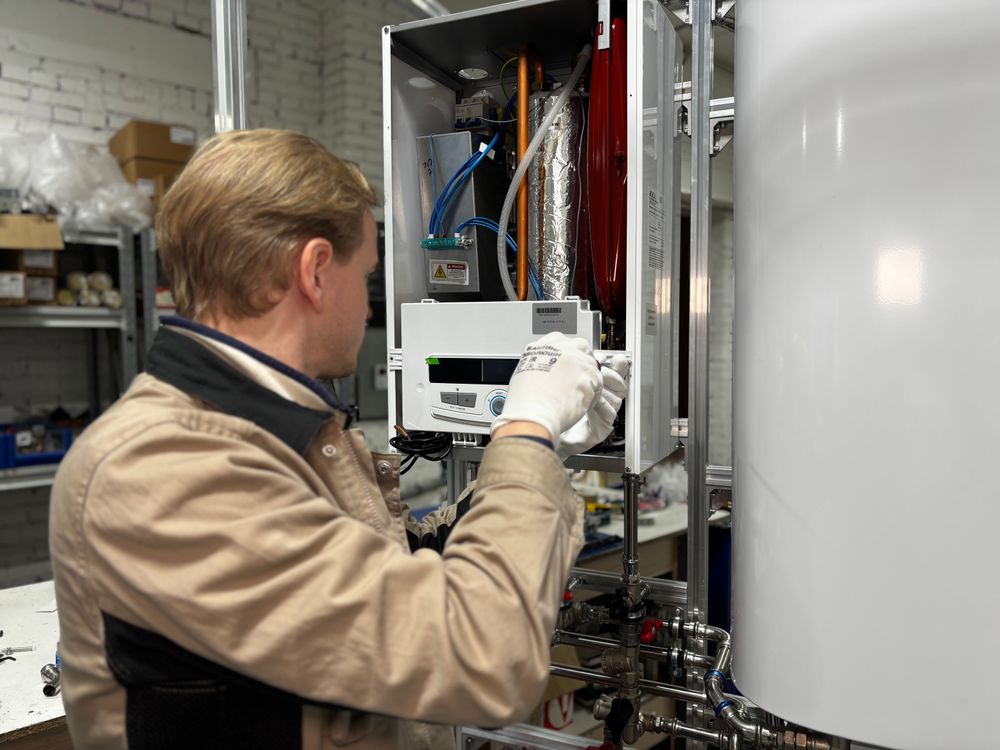
If garage space is tight, ask how a wall-mounted tankless unit compares.
Expansion tanks in newer homes
Many homes built since the 1990s have a check valve or backflow device where the water line enters, which makes the plumbing a closed system. When the heater warms the water, the extra volume has nowhere to go and pressure climbs with every cycle, straining the tank, the connectors and the fixtures. It often shows up as a relief valve that drips just after the heater runs. An expansion tank on the cold supply, with an air cushion behind a diaphragm, absorbs that extra volume. Its air charge fades over the years, so an older one may need checking at the same time as a heater repair. The installer sets the charge to match the home's water pressure, and a tank whose diaphragm has failed is replaced rather than recharged. Read more at expansion tank installation.
The relief valve and why it must stay open
Every tank has a temperature and pressure relief valve near the top, with a discharge pipe running down beside the heater. If the water gets too hot or the pressure too high, the valve opens and releases water so the tank doesn't fail. A drip is a message: usually pressure building in a closed system, sometimes a temperature set too high, occasionally a worn valve. The one thing never to do is cap or plug the valve or its pipe. Report it, and the technician will find the cause and replace the valve or add an expansion tank. The discharge pipe should end low, near the garage floor or outside, where released water can't cause harm, and it's checked at every replacement. Learn more about pressure relief valve service.
Electric faults
When nothing comes out hot, suspect the upper element, its thermostat or the high-limit cutoff. A tank that empties quickly of hot water often has a worn lower element. Water far too hot means a thermostat stuck on, and a breaker that keeps tripping points to a shorted element, which should be reported rather than reset. These parts sit behind covers next to live wiring, so describe the symptom and let the technician diagnose it. On a sound tank, most are single-visit repairs. On a builder heater well into its second decade, especially one also showing rust or rumbling, the same fault is often the moment to weigh replacement. Read more at electric water heater repair.

When a standard tank is simpler
A heat pump unit isn't right for every home. In a villa closet, a garage too full to leave space around it, or where there's no route for condensate, another standard electric tank is simpler. A household that uses a lot of hot water in a short burst may do better with a larger standard tank. The installer will price the options side by side, including running costs and the upkeep each needs, so the choice is clear.
Water heater services in Port St. Lucie
- Heat Pump Water Heater Installation
- Expansion Tank Installation
- Pressure Relief Valve Service
- Electric Water Heater Repair
- Tankless Water Heater Installation
Give the serial number on the label and a pro will say whether to repair or plan ahead.
Port St. Lucie water heater questions
In Port St. Lucie, can we upsize when we replace the heater?
Usually, if the garage has room. A larger tank needs floor space and headroom, and a heat pump model on a stand is taller still. The installer measures, checks the electrical supply and compares first-hour ratings against your household's busiest hour.
For a Port St. Lucie home, does a water softener help the water heater?
A softener reduces the minerals that form scale and sediment, so flushing is needed less often and elements tend to last longer. Softened water can wear the anode faster, though, so have it checked at each service and replaced before it's spent. A technician can suggest a suitable anode for softened water.
For a Port St. Lucie home, our subdivision is only a few years old. Will our heater need attention yet?
Not replacement, but some care now helps. A flush early on keeps sediment from hardening, an anode check a few years in protects the tank, and a leak sensor gives early warning. A relief valve that drips after heating usually means an expansion tank is needed.
In Port St. Lucie, can someone come the same day?
Often, depending on the time of the call and local availability. When you call, we'll connect you with a local pro and you'll hear when they can arrive. If the heater is leaking, close its cold supply first and mention the leak when you call, so the pro knows it can't wait until tomorrow.
For a Port St. Lucie home, why does the relief valve drip just after the heater runs?
Usually because water expands as it heats and, in a closed plumbing system, pushes the pressure up; an expansion tank normally cures it. A worn valve or high temperature setting can also cause it. The valve must never be capped.
For a Port St. Lucie home, what maintenance does a heat pump water heater need?
Clean its air filter regularly, keep the condensate line clear, and have the tank flushed and the anode checked like any other tank. A technician can check the heat pump itself if the unit stops heating efficiently or starts running on its elements more than it should.
Our 2000s house still has the builder's heater and the element has failed. Repair or replace?
If the tank is dry and rust-free, a new element is a sensible repair. If there's rust at the base, damp or loud rumbling too, the tank is nearing the end, and a replacement, perhaps a heat pump unit, is usually better value.
Do you cover all six Port St. Lucie ZIP codes?
Yes. We cover every Port St. Lucie ZIP code, from the older neighborhoods along the North Fork to the newer communities in the west. Give us your address and any gate details when you ring, and we'll put you through to a local pro.
Nearby communities
We also cover Jensen Beach, Fort Pierce, Stuart and the rest of the Southeast Coast.
Port St. Lucie water heater repair?
Call any time for a local pro who repairs and replaces heaters across Port St. Lucie's homes.
Garages and closets across St. Lucie County.