
Crestview · Okaloosa County
Water Heater Repair and Replacement in Crestview, FL
Is the hot water running out halfway through the second shower, or has the tank started to rumble? In Crestview, where much of the housing is only a few decades old, a heater that is losing capacity is often a matter of what has built up inside it. We ask a few questions about the heater, then connect you with a local pro. If it's a repair or a full replacement, a local Crestview pro can look at it.
Both Crestview ZIP codes, from the streets around downtown to the newer subdivisions on the edges.
What minerals do inside a tank
Every gallon a heater warms carries dissolved minerals, mainly calcium and magnesium, and how much depends on the supply. Heat drives some of them out of the water, and they settle on the tank floor as sediment and coat the elements as scale. The layer buries the lower element on an electric heater, which then runs hotter and fails sooner, and on a gas heater it sits between the burner and the water. Water trapped beneath the sediment boils in small bursts, which is the rumbling or popping many owners hear. Sediment also takes up room that should hold hot water, so the tank seems to run short. The anode rod, which corrodes so the tank doesn't, wears steadily too, and once it's spent the steel itself begins to rust from the inside, which no flush can reverse. See noisy water heater and sediment.
Water heater repair and replacement in Crestview
Crestview grew from the railroad that crossed the western Panhandle, and its name describes its spot: it sits on the crest of the watershed between the Yellow and Shoal rivers. Its first economy was the longleaf pine, tapped for turpentine and cut at sawmills. The city incorporated in 1916, a year after Okaloosa County was created, and in 1917 voters made it the permanent county seat, taking the role from the sawmill town of Milligan. Two ZIP codes, 32536 and 32539, carry a Crestview address, home to about 44,800 people.
Much of the housing is recent. By Census count, about 34% of homes in the 2000s, 22% in the 1990s and 20% in the 1980s, with 10% from the 1970s, 6% from the 1960s, 4% from the 1950s and around 4% older or newer. Single-family houses make up most of it, with the heater in an attached garage or a utility room, and older homes near downtown keep it in a closet or back room. Most heaters are electric, and where natural gas reaches the street, some homes have gas.
With only about 1% of homes held for seasonal use, almost every heater is in daily service. Homes are on a public water supply, and winters bring noticeably cooler water into the heater, which is why a heater that seemed ample in the first few years can start to fall short.
For installation work, the age of the housing matters in two ways. Builder heaters from the 2000s are now in their second decade and reaching the point where replacement beats repair, while the 1980s and 1990s homes are mostly on their second or third heater. In both cases the spot is usually a garage with room, which makes the choice of size and type a real one and not a matter of squeezing in whatever fits.
Our Crestview coverage runs through ZIP codes 32536 and 32539.
What flushing can and can't undo
A technician's flush runs water through the tank to carry loose sediment out of the drain valve. Done every year or two from early in a heater's life, it keeps the lower element clear, quiets the rumbling and helps the tank deliver the hot water it was built for. It can't dissolve sediment that has hardened into a crust, rebuild an anode that has worn away or repair a tank that has begun to rust. On an older heater that has never been flushed, disturbing a hard layer can strain the drain valve, so the technician judges first whether it will help. When a tank is past that point, replacement plus a flushing routine for the new heater is the better plan. Details are in water heater flushing and maintenance.
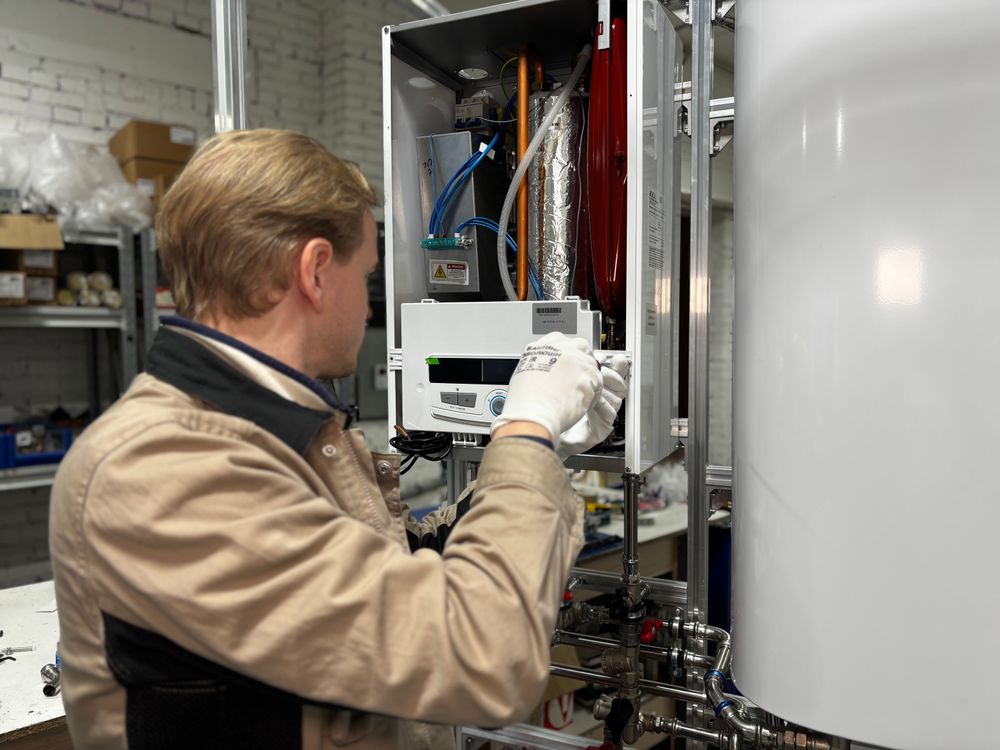
Hot water fading on cold mornings? Describe it, and a pro will say whether size or a fault is behind it.
Cooler winter water
In a Panhandle winter, the water reaching the heater is noticeably colder than in August. Each gallon takes longer to heat, the tank recovers more slowly, and a heater that coped all summer can run short on a busy January morning. A failed lower element or thick sediment gives the same symptom, so have the heater tested before assuming it's undersized. When a new heater goes in, size it for the coolest busy morning. A tankless unit loses output when the water is cold, since it has more temperature to add, so it must be sized for January. Read more at water heater not heating enough.
Gas water heaters
Where natural gas is available, a gas tank heater recovers quickly when winter water arrives cold, and it can be an option at installation if a line reaches the home. It burns gas beneath the tank and sends the exhaust through a vent pipe or a powered vent, so the burner, controls and venting need inspection by a technician who works on gas appliances. If a home has no gas, an electric tank or heat pump unit is the usual choice. If you smell gas at any point, get everyone out and call your gas utility and 911 from outside. More on gas water heater service.

Weighing a standard tank against a heat pump unit? A pro can quote both on the same visit.
Electric faults
No hot water at all usually points to the upper element, its thermostat or a tripped high-limit cutoff; hot water that runs out quickly points to the lower element, often under sediment. A breaker that trips repeatedly usually means a shorted element and should be reported, not reset. With live wiring behind every cover, the safe move is to describe the symptom and let a pro test it. On a tank late in its second decade, repeated faults usually make replacement the better value, and it's the moment to decide whether the size and type still suit the household. Read more at electric water heater repair.
Choosing the size and type
The replacement can differ from what was there before. Start with the household's busiest hour: how many showers, loads of laundry and dishwasher cycles overlap on a typical morning. A 40-gallon tank suits a small household, while larger families usually want 50 gallons or a quicker-recovering type. If the garage has room, a heat pump unit uses much less electricity, and a tankless unit saves floor space but must be sized for winter water and may need a larger electrical supply. The installer measures the space, checks the shutoff, relief line and pan, and lays out the choices before work starts. Details are in water heater installation.
Water heater services in Crestview
- Water Heater Installation
- Flushing and Maintenance
- Noisy Water Heater and Sediment
- Water Heater Not Heating Enough
- Gas Water Heater Service
- Electric Water Heater Repair
Nearby communities
We also cover Baker, Niceville, DeFuniak Springs and the rest of the Panhandle.
Crestview water heater questions
For a Crestview home, will a heat pump water heater work in a cold garage?
Yes. On cold days it draws less heat from the air and leans more on its backup elements, so it's less efficient for those hours. Across a full year, though, it still spends most of its time in its efficient mode in a Panhandle garage, and the installer can check the space first.
For a Crestview home, are gas water heaters common here?
Where natural gas reaches the street, yes, and they recover quickly in winter. Many homes have no gas line, so electric tanks are the usual choice, with heat pump units picked more often at replacement. The installer can confirm what's available at your address.
For a Crestview home, why do we run out of hot water in winter but not summer?
Incoming water is much colder in winter, so the heater has to raise it further and delivers less hot water in a busy hour. If the heater tests fine, it may simply be sized for summer. A failing element or sediment can add to the problem.
In Crestview, our home is about fifteen years old and still has its first heater. Should we replace it now?
Not necessarily, but plan for it. Many tanks last around ten to fifteen years, so yours is on borrowed time. A technician can check the anode, the fittings and the tank for rust or damp, and tell you whether to wait or schedule a replacement on your own terms.
In Crestview, why does the relief valve drip just after the heater runs?
Often because pressure rises as water heats, particularly where a check valve or backflow device on the supply closes the system. A small expansion tank can take up the extra volume. A worn valve can drip for other reasons, so a technician tests the pressure before recommending a fix.
How long will an installation take?
A like-for-like tank swap in an open garage is often finished within a few hours, plus time for the new tank to heat. Tight access, a clogged drain valve, extra fittings or a change of type take longer. The technician gives a timeframe along with the price.
Can I install the heater myself to save money?
We'd advise against it. A heater joins water, power or gas, a relief valve and a drain line, and a mistake in any of them can cause damage or injury. A local pro handles the connections and the relief line, and agrees the price before work starts.
Do you cover both Crestview ZIP codes?
Yes. We cover 32536 and 32539, from the older streets near downtown to the newer subdivisions on the edges and the rural roads around the city. Give us your address and any gate details when you phone, and we'll pass the job to a local pro.
Crestview water heater installation?
Call any time for a local pro who installs, replaces and services heaters across Crestview and northern Okaloosa.
Garages, utility rooms and closets in both ZIP codes.