
Starke · Bradford County
Water Heater Repair and Replacement in Starke, FL
On a January morning in Starke, the water entering the heater is far colder than in July, and an old or undersized tank shows it by the second shower. Winter is when most heaters here give themselves away, and a good moment to plan the next one. For repair or replacement in Starke, call and we'll connect you with a local pro.
Town streets, farm roads and every home in 32091.
Water heater repair and replacement in Starke
Starke grew around the railroad. In 1857 the line from Fernandina on the Atlantic to Cedar Key on the Gulf was built through the settlement, and a post office opened that November. The town was incorporated on April 4, 1870, and in 1875 Bradford County voters narrowly chose to move the county seat here from Lake Butler, a question not finally settled until 1921. Timber and oranges were the early exports until freezes in the late 1890s ended the citrus trade, and strawberries took their place. During the Second World War, thousands of soldiers training at nearby Camp Blanding passed through the town.
Starke's single ZIP code, 32091, is home to about 15,500 people across the city and the surrounding county. The housing spans more than a century. The Census tallies about 24% of homes before 1960, including 5% from before 1940, with 8% from the 1960s, 20% from the 1970s, 17% from the 1980s, 17% from the 1990s and 13% from the 2000s. That mix includes frame houses near downtown with the heater in a utility room or on an enclosed porch, block homes with a carport closet or laundry room, newer houses with an attached garage, and manufactured homes on country lots where the heater sits in a small compartment.
The City of Starke runs its own utility, which describes itself as Florida's oldest municipal utility, and it supplies groundwater from wells as well as natural gas. Homes outside the city often rely on private wells. About 2.9% of homes are held for seasonal or occasional use, according to Census data. And as in all of North Florida, winter brings genuinely cold mornings and much colder water to the heater. Put together, that means a heater call here can involve almost anything: a gas tank in a 1930s utility room, an electric tank in a 1990s garage, or a compartment unit in a manufactured home on a well.
Our Starke coverage runs through ZIP code 32091.
Where heaters ended up in older homes
Houses built before the 1950s predate the attached garage as the usual place for a water heater, so in Starke's older homes it sits wherever space was found later: a utility room off the kitchen, a hall closet, an enclosed back porch, a laundry corner or a small outbuilding. Many of these spots have seen three or four heaters come and go, each connected to fittings left by the one before. It's common to find a fairly new tank joined to a shutoff valve and connectors several decades older, and those older parts are where many leaks start.
That shapes an installation. The old tank is drained in place and carried out through the house, clearances may call for a slimmer or taller model, and a gas heater's vent route may be long. It's also the chance to add what the space has lacked for decades: a drain pan with an outlet piped somewhere useful, a shutoff valve that turns freely and new connectors. In a manufactured home, the heater is usually replaced with a model designed for that kind of home, which fits its compartment and connections. Details are in drain pan and overflow protection.
Raised floors and old piping
Many older houses here, and every manufactured home, stand above the ground rather than on a slab. A leak from a heater in a closet or compartment soaks into the floor structure and can go unnoticed for some time; floors in many manufactured homes suffer quickly when wet. A pan with a working outlet and a leak detector beside the heater are worth far more in these homes than in a garage.
Older homes may also still have galvanized steel pipes, or a patchwork of materials from earlier repairs. Galvanized pipe corrodes inside and can shed rust, so brown water isn't always the heater's fault. If both hot and cold run discolored, the pipes or supply are the likely source; if only the hot does, the tank is more likely. The installer checks before recommending anything, and will say plainly if a new heater alone won't cure discolored water.
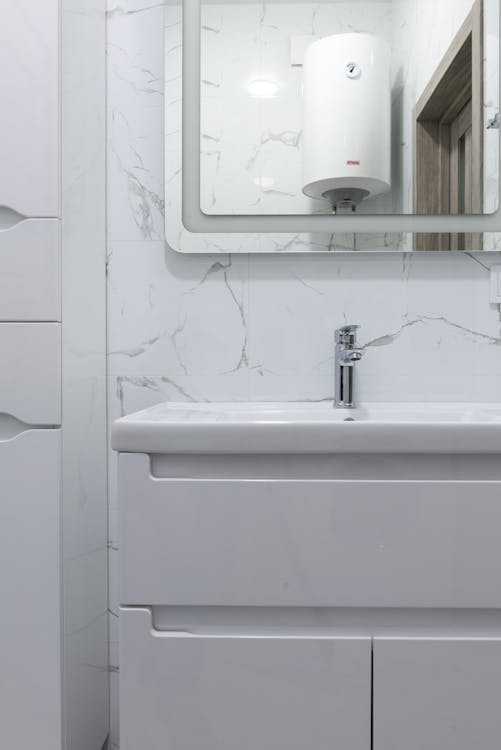
Lukewarm, brown, noisy or wet: tell us and a pro will explain what it points to.
Gas heaters in town
Because the city supplies natural gas, a gas water heater is an option for many homes in town, and some rural homes use propane, though electric heaters are still common. A gas tank or tankless heater recovers quickly, which helps on cold mornings. Each one relies on a vent that carries its exhaust outside, a supply line sized for the unit and enough combustion air, and all three are checked at installation. Switching an older home from electric to gas, or the reverse, is often possible, though it adds a gas line and vent in one direction or a suitable circuit in the other. If you smell gas, leave the building and call your gas utility and 911 from outside. See gas water heater service.
Sizing for January
Colder winter water means every gallon needs more heating and a tank recovers more slowly, so a heater that coped in summer can run short on a winter morning. Before sizing up, have the heater checked for a failed lower element or broken dip tube. At installation, choose a tank by its first-hour rating against your busiest winter hour. Tankless units need sizing for the coldest water too, since they deliver fewer gallons a minute at shower temperature in January. A heat pump unit is another option for a roomy garage, with its backup elements covering the coldest mornings. Details are in water heater sizing guide.
A rotten-egg smell on well water
On a private well, a sulfur smell from the hot taps only is commonly associated with sulfate in the water reacting with the anode rod in the warm tank. A technician confirms the cause on site and usually fits a less reactive or powered anode, often with a flush. If the cold water smells too, the gas is already in the well water, a matter for well treatment rather than the heater. Removing the anode is never the answer, because the tank then rusts much faster. The smell can also appear in a home that has stood empty for a while, and often fades once the hot water is being used again. Learn more about rotten-egg smell in hot water.
Water heater services in Starke
- Water Heater Installation
- Drain Pan and Overflow Protection
- Gas Water Heater Service
- Tankless Water Heater Installation
- Water Heater Sizing Guide
- Rotten-Egg Smell in Hot Water
- Manufactured Home Water Heaters
If the new heater can go in a roomy garage, ask whether a heat pump suits it.
Starke water heater questions
Will a tankless heater keep up on winter mornings here?
Yes, if it's sized for winter. Cold incoming water reduces how many gallons a minute a unit can bring to shower temperature, so installers around Starke choose models for January rather than the average. Tell the installer how many showers and appliances run at once.
Should we fit a sediment filter on our well?
If the well brings sand or silt, a whole-house sediment filter, kept serviced, cuts down what settles in the heater and fixtures. Whether you need one depends on the well. Issues like iron or sulfur are a separate matter for a water treatment specialist.
Our hot water is suddenly scalding. What's happening?
A thermostat stuck on is the usual cause, heating the water past its setting. The heater's high-limit cutoff is meant to stop it, but it may be failing too. Use cold water carefully at the taps and call; this needs a technician promptly.
Is a tankless water heater a good choice in Starke?
It can be, if it's sized for winter water and your supply can support it. Where the city's gas reaches, a gas tankless unit is practical; whole-house electric models need a lot of electrical capacity. All tankless units need periodic descaling to stay efficient.
What size water heater should we install?
That depends on your busiest hour more than bedrooms: how many showers run back to back, whether there's a large tub, and which appliances run at the same time. Here, allow for colder winter water too. The installer uses the first-hour rating to match it.
For a Starke home, can a leaking tank be patched?
No. Once the steel tank has rusted through, there's no lasting repair, and the leak will only grow. If the water comes from a fitting, the relief valve or the drain valve instead, that part can usually be replaced. The technician will show you which it is.
Our 1940s house has the heater on the back porch. Can the new one go there?
Usually, yes. The installer checks the space, the floor beneath it and the route out through the house, and may suggest a slimmer or taller tank. Adding a pan with a proper outlet and a leak detector is worthwhile, especially on a raised wooden floor.
Do you cover the farms and rural homes around Starke?
Yes. We cover the whole of 32091, from the downtown streets to the farm roads, manufactured homes on country lots and homes on private wells. Give us your address, and directions if the house is set back from the road, when you call.
Nearby communities
We also cover Keystone Heights, Lake Butler, Middleburg and the rest of North Florida.
Starke water heater installation?
Call any time for a local pro who installs and repairs heaters in Starke's older homes, newer houses and manufactured homes.
Porches, closets, compartments and garages.