
Edgewater · Volusia County
Water Heater Repair and Replacement in Edgewater, FL
Edgewater began as a handful of houses on the Indian River with a citrus grove and a few hives of bees; by 1887 it had forty-one houses. Most of what stands today was built a century later, mainly in the 1980s and 1990s, which is why so many heaters here are now on a second tank or arriving at the end of their first. If it's a repair or a full replacement, a local Edgewater pro can look at it.
Both Edgewater ZIP codes, 32132 and 32141, from the river side to the neighborhoods west of the highway.
If the heater is leaking
First, stop the water: close the valve on the cold-water pipe going into the top of the heater, or the main shutoff for the home or unit if you can't reach it. Keep clear of the heater's electrical parts and any water near them. Move belongings out of the way and lay towels at the closet door. If the leak is in a condominium, tell the association or management office so staff can reach neighboring units, and let the neighbors know. Then call, saying where the water is coming from. If you ever smell gas near a heater, leave the building and call your gas utility and 911 from outside. Details are in condo water heater leak.
Water heater repair and replacement in Edgewater
The land that became Edgewater was bought in 1865 by Dr. John Milton Hawks, who settled on it in 1874. By 1887 the settlement had forty-one houses, and citrus and beekeeping were its main trades; in 1888 steamboats carried eleven tons of its honey away. It was incorporated in 1915 as the Town of Hawks Park, and in 1924 the Legislature renamed it Edgewater. It lies on the Indian River beside Mosquito Lagoon, between New Smyrna Beach and Oak Hill. Two ZIP codes, 32132 and 32141, carry an Edgewater address, home to about 24,900 people.
Per Census figures, about 35% of homes in the 1980s, 23% in the 1990s, 16% in the 1970s and 16% in the 2000s, with 5% from the 1950s and around 5% older or newer. Single-family houses make up most of it, with the heater in a garage or utility room, while condominiums and townhomes keep it in an interior closet, often beside the air handler. Nearly every heater is electric, and a good many in the older blocks are on their second or third tank.
By Census data, roughly 4.8% of homes are seasonal. Homes are on a public water supply, and near the river and the lagoon, salt air reaches exposed fittings.
For installation work, the building years do the talking. Houses from the 1980s are mostly on their second heater, and the builder heaters of the 1990s are well into their second decade, so many calls are about a planned replacement. Rentals are common too, which changes who calls and who arranges access, and the sections below cover that along with closets. Knowing the heater's age helps, so photograph the rating label on the tank and read the serial number out when you call, and the technician can arrive knowing which model and which spot to expect.
Local installers take Edgewater calls from 32132 and 32141.
Closets, access and drain pans
A heater in an interior closet has little room around it, so a replacement starts with measuring: the height under the shelf, the clearance beside the air handler, the position of the shutoff and the route of the relief valve line. A pan with a working outlet matters because floors in closets seldom tolerate water, and the pan outlet shouldn't be blocked by stored items. Telling us the unit, the building's access rules and whether the service elevator needs booking lets the right pro and the right tank arrive together. See condo water heater replacement.

Read the serial number off the label and a pro will say whether replacing it now makes sense.
Choosing the size at installation
A new heater doesn't need to copy the old one. Start from the household's busiest hour: how many showers, loads of laundry and dishwasher cycles overlap on a typical morning. A rental that has changed hands, or a home whose household has grown or shrunk, may need a different size now. On a tank, compare the first-hour rating on the label, which combines what it holds with how fast it reheats. The installer measures the space, checks the shutoff, relief line and pan, and lays out the choices, including a heat pump unit where a garage has room, before work starts.
Rental properties
For a rental, a heater problem involves more than one person. A tenant should contact the landlord or property manager first, since the lease normally sets out how repairs are arranged. A landlord can keep a simple record of each property's heater type, location and manufacture date, show each tenant where the shutoff is and fit a connected leak sensor beside the heater. A vacancy is a good time to replace an older tank, because the home is empty, access is easy and no tenant is left without hot water. When we're called, the pro arranges access with the tenant and agrees the price with whoever is arranging the work. Learn more about drain pan and overflow protection.
Planning around a heater's age
A heater in its first decade with one failed part is usually worth repairing. One well into its second decade, with rust at the base, brown hot water, a rumble that a flush no longer quiets or water from the tank body, is better replaced on a day you choose than on a day it fails. For a rental, a vacancy is the easiest time; for an owner-occupied home, a planned weekday visit leaves time to choose the right size and type. Details are in water heater installation.
Salt air by the river and the lagoon
Close to the Indian River and the ocean breeze, salt settles on brass valves, copper fittings and braided connectors, and they grow a white or green crust. A joint beneath it can weep slowly, leaving a mineral streak down the jacket long before a puddle forms. Heaters in garages and open utility rooms show it first. A look at the top of the tank every few months, and crusted parts renewed at the next visit, prevents many leaks. At installation, valves and connectors are renewed with the tank. Details are in water heater replacement.
The anode rod and the smell
Inside the tank, a metal anode rod corrodes on purpose so the steel doesn't. When it's used up, the tank begins to rust from inside, which can't be reversed, so an anode check around the middle of a heater's life is worthwhile. A rotten-egg smell from the hot taps only is commonly associated with sulfate in the water reacting with that rod, with bacteria in warm, still water playing a part, and a technician confirms the cause on site and usually fits a different type of anode. Taking the rod out isn't a fix. Details are in anode rod replacement.
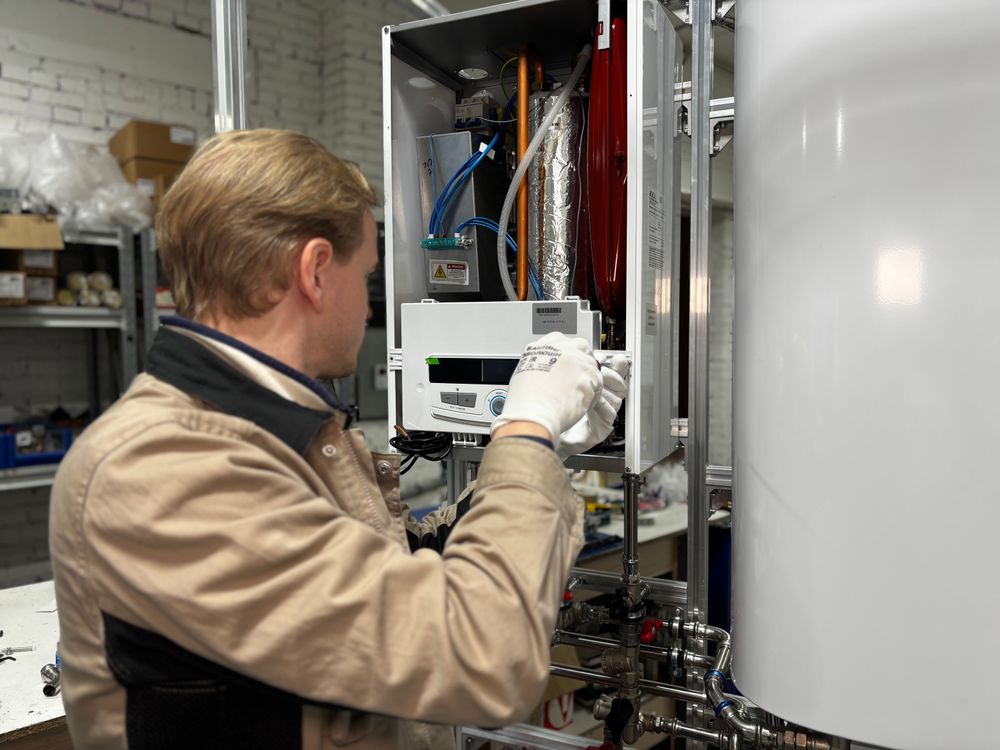
Heater in its second decade? Ask a pro to check the anode and the tank before deciding.
Water heater services in Edgewater
- Water Heater Installation
- Condo Water Heater Leak
- Condo Water Heater Replacement
- Anode Rod Replacement
- Drain Pan and Overflow Protection
- Rotten-Egg Smell in Hot Water
Edgewater water heater questions
What should I find out from the building before a condo replacement?
Ask the office how contractors sign in, which days and hours work may happen, whether the service elevator has to be reserved and where a van can park. Associations also differ in what they expect about water heaters, so ask about that too and pass everything on when you call.
In Edgewater, how is an old heater taken out of an upper-floor condo?
The tank is emptied inside the unit first, which makes it far lighter. The technician then wheels or carries it out by the service elevator or the stairs, with floors and walls protected. Tell us the floor and any elevator booking when you call.
In Edgewater, i rent my home. Who should I call when the hot water stops?
Begin with your landlord or property manager, since the lease normally says how repairs are handled. If they want us to step in, or they phone us themselves, we'll put a local pro in touch with you to arrange access, and the price is agreed with whoever is organizing the work.
In Edgewater, water is coming through my ceiling from the unit above. What should I do?
Ring the association or management office at once, because staff can enter the unit above and close its supply. Knock on the neighbor's door as well if you can. Move your belongings, stay away from wet light fittings and switches, take photos, and then get in touch with your own insurer.
In Edgewater, is my garage suitable for a heat pump water heater?
Usually, if the garage offers four things: open air around the unit, a drain route for condensate, enough headroom for a taller tank and a suitable electrical supply. The installer checks each before suggesting one, and compares its price with a standard tank.
In Edgewater, do homes near the water need extra attention for their heaters?
Yes, a little. Air carrying salt eats into exposed valves, connectors and fittings faster than inland air does, which shows soonest on heaters in garages, carports and outside closets. Checking the connections on top of the tank now and then, and renewing corroded parts at the next visit, heads off many leaks.
How long does an installation take?
A like-for-like tank swap in an open garage is often finished in a few hours, plus time for the new tank to heat. A condo closet, tight access, a clogged drain valve or a change of type takes longer. The technician gives a timeframe along with the price.
Do you cover both Edgewater ZIP codes?
Yes. We cover 32132 and 32141, from the river side to the neighborhoods west of the highway. Give us your address and any building or gate details when you call, and we'll connect you with a local pro who works in southeast Volusia.
Nearby communities
We also cover New Smyrna Beach, Port Orange, Daytona Beach and the rest of Central Florida.
Edgewater water heater installation?
Call any time for a local pro who installs, replaces and services heaters across Edgewater.
Garages, utility rooms and condo closets in both ZIP codes.